
The Impact of using Progress Learning in a Flex Blended Environment
Overview
The reason behind this study is to explore how integrating a digital math tool, like Progress Learning, in a flex blended environment can influence math performance and student engagement in a 3rd grade classroom. I am an educator that is committed to student centered practices and instructional methods that provide learners with flexibility, personalization, and immediate feedback. My innovation plan combines Schoology, project based learning, and small group instruction, yet also incorporates the use of digital applications, such as Progress Learning to enhance comprehension, achievement, and confidence for learners. This comprehensive approach calls for customized, technology integrated learning experiences to meet the needs of diverse learners.
Fundamental Research Question
In what ways does the use of Progress Learning impact the quality of 3rd grade academic math performance using a flex blended learning approach with a learning management system, such as Schoology, project based learning, and small group instruction?
This research question is significant because it aligns with integrating digital tools and prioritizing instructional designs with student engagement and flexibility. By researching deeper on how adaptive learning tools can affect the outcomes in a flex blended model, educators can gain evidence-based strategies to fill in the learning gaps for students, and improve their overall academic success.
Summary of the Literature Review
In this literature review, key themes are highlighted, like the effectiveness of blended learning models in increasing academic performance and student engagement (Horn & Staker, 2015). There is also a focus on adaptive platforms, like a digital application called Progress Learning, which has been proven to be very impactful in supporting diverse learners in a significant learning environment. Progress Learning offers standards-aligned questions, real-time progress monitoring, personalized practice, and differentiated assignments that are geared towards the students’ individual needs. These features give teachers the ability to effectively target instruction which allows students to move at their own level and pace, while enabling them opportunities to take on greater ownership of their learning. Researchers have shown that such personalization can close learning gaps and significantly improve math scores and outcomes (Cheung et al., 2013). This learning platform includes built-in performance dashboards, formative assessments, and immediate feedback, which all assist with tracking students growth and metacognitive development of their strengths and improvement areas. Additionally, studies have emphasized how small group instruction plays a significant role in supporting differentiated learning (Fullan, 2013). It has also been proven that project based learning will enhance learners with real world problem solving skills (Bell, 2010). Plus, the CSLE + COVA framework further supports the creation of a significant learning environment where students have choice, ownership, voice, and authentic learning opportunities to deepen student engagement, build self-confidence, and promote lasting understanding (Harapnuik et al., 2018).
Study Information
With a growing interest in personalized and student centered instruction, this action research explores how combining technology with project based learning and small group instruction in a flex blended learning environment can be impactful for both student engagement and achievement in 3rd grade math. The study is grounded in the belief that creating significant learning environments promotes choice, ownership, voice, and authentic learning opportunities (Harapnuik et al., 2018). It also aims to prove that using digital tools in the classroom can support these principles and framework in daily practice. In essence, by using a mixed methods approach, this research provides measurable data and meaningful insights that guides instructional decisions and supports innovative strategies in the classroom.
Research Design
In this study, a mixed methods research design is used that combines both quantitative and qualitative approaches to provide an understanding of how Progress Learning makes an impact on student engagement and achievement. The quantitative component uses data from the pre and post assessments in Progress Learning, along with district math benchmark scores, to measure the growth of students academic success. The qualitative part includes student reflections, informational surveys, and teacher observations which offer insights into the engagement levels, self-confidence, and student perceptions of their own math experience. Therefore, using a mixed methods approach improves the depth and validity of findings by including numerical results and contextual understanding (Creswell & Plano Clark, 2018). This design is meant for educational research because both outcomes and learning experiences are necessary for evaluating success (Ivankova et al., 2006).
Data Collection and Analysis
The action research plan consists of collecting data over a 12 week instructional period. Quantitative Data includes Progress Learning Analytics, such as assessment scores, completion rates, and time-on-task, along with district benchmark results to evaluate academic progress (Black & William, 1998). Qualitative data is gathered through student surveys, teacher notes, and observational checklists which will assess student engagement, self-perception, and overall confidence of learning (Creswell & Plano Clark, 2018). Therefore, see Appendix A for a Likert-scale Student Survey, Appendix B for Pre and Post Assessment examples, and Appendix C for an Observational Checklist, as they are attached as appendices down below. Data analysis will include comparing the outcomes from pre and post assessments to observe academic growth, identifying trends in the responses to the student surveys, and reflective observations to identify anything related to engagement and learning confidence (Miles, Huberman, Saldana, 2014).
Research Participants Privacy and Ethics
Before beginning, I will inform my students and their parents of how we will be integrating Progress Learning to track academic improvement and student engagement in our classroom with my innovation plan in a flex blended approach using Schoology, project based learning, and small group instruction. In order to protect the privacy and rights of all of my students, I would inform both students and parents of how we will be collecting data and what we will be using (refer to the appendices below). Instead of using student names, I could use code identifiers. Therefore data would be kept confidential only to support improvements to instruction, following the district policies and ethical guidelines.
Action Research Timeline and Implementation Plan
Phase 1: Preparation & Setup (Weeks 1–2)
Goal: Have a clear baseline for students’ math proficiency and engagement.
Phase 2: Implementation & Data Collection (Weeks 3-8)
Goal: Actively observe changes involving engagement, confidence, and performance.
Phase 3: Post-Assessments, Survey Collections & Reflection (Weeks 9-10)
Goal: Measure growth and identify trends from student experiences.
Phase 4: Action Planning & Sharing (Weeks 11-12)
Goal: Share results, reflect on successes and challenges, then plan next steps
Sharing and Communicating Results
I plan to share the results from this action research with fellow teachers, instructional coaches, and campus administrators. I chose these individuals because they directly support instruction, and curriculum planning throughout a school year. I will also share my findings in professional learning communities, or PLC meetings. And, I will conduct a formal presentation, and a digital summary through my ePortfolio. I plan to use both a narrative, and visual formats to interpret the results from exploring Progress Learning effectively in a classroom. Sharing results in a professional learning community supports a culture of collaboration and ongoing growth, which is necessary for sustainable instructional improvement (DuFour & Fullan, 2013).
Final Reflection
Conclusively, I will reflect on this evolving action research process through journaling, discussions, and documentation. I will also make updates to my ePortfolio to keep it current and reflective of the new information that was discovered after analyzing all results, and receiving feedback. My reflection will focus on how this study has ultimately influenced my innovation plan, and how student learning was impacted in the classroom using Progress Learning as a digital learning tool for academic improvement and student engagement. I will include information on how this process has shaped my growth as an educator, and researcher. Ultimately, this experience will be used as a meaningful foundation to inspire student centered focus, ongoing professional learning, and continuing innovation in education.
References
Bell, S. (2010). Project-based learning for the 21st century: Skills for the future. The Clearing House: A Journal of Educational Strategies, Issues and Ideas, 83(2), 39–43. https://doi.org/10.1080/00098650903505415
Black, P., & Wiliam, D. (1998). Inside the black box: Raising standards through classroom assessment. Phi Delta Kappan, 80(2), 139–148.
Cheung, A. C. K., & Slavin, R. E. (2013). The effectiveness of educational technology applications for enhancing mathematics achievement in K-12 classrooms: A meta-analysis. Educational Research Review, 9, 88–113. https://doi.org/10.1016/j.edurev.2013.01.001
Creswell, J. W., & Plano Clark, V. L. (2018). Designing and conducting mixed methods research (3rd ed.). SAGE Publications.
DuFour, R., & Fullan, M. (2013). Cultures built to last: Systemic PLCs at work. Solution Tree Press.
Fullan, M. (2013). The new meaning of educational change (4th ed.). Teachers College Press.
Harapnuik, D., Thibodeaux, T., & Cummings, C. (2018). Developing significant learning environments. Lulu.
Horn, M. B., & Staker, H. (2015). Blended: Using disruptive innovation to improve schools. Jossey-Bass.
Ivankova, N. V., Creswell, J. W., & Stick, S. L. (2006). Using mixed-methods sequential explanatory design: From theory to practice. Field Methods, 18(1), 3–20. https://doi.org/10.1177/1525822X05282260
Miles, M. B., Huberman, A. M., & Saldaña, J. (2014). Qualitative data analysis: A methods sourcebook (3rd ed.). SAGE Publications.
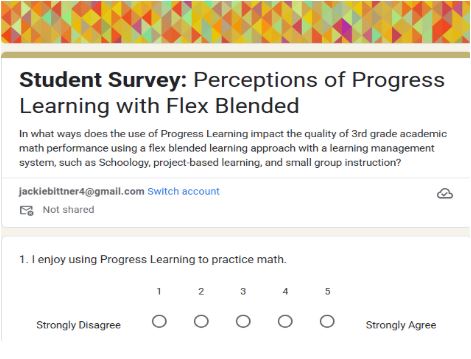
Appendix A – Student Survey: Perceptions of Progress Learning with Flex Blended
Student Survey: Perceptions of Progress Learning with Flex Blended
Appendix B: Pre- and Post-Assessment from Progress Learning for 3rd Grade Math Skills (Aligned with TEKS Standards)
Purpose:
Students will complete the Pre and Post Diagnostic Tests to measure student growth in 3rd grade math (TEKS-aligned skills for a before and after implementation of the flex blended learning approach using Progress Learning). Note: These should be completed in Progress Learning for more accurate results.
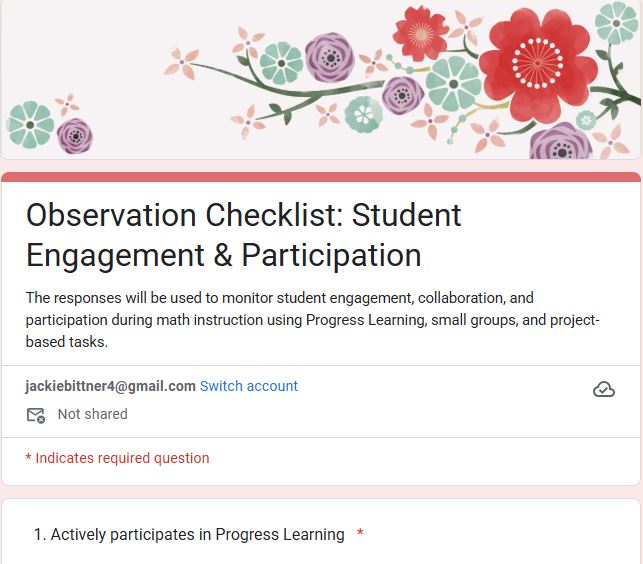
Appendix C: Teacher Observation Checklist: Student Engagement & Participation
Teacher Observation Checklist: Student Engagement & Participation
Peer Review – Feedback/Feedforward
Cristy Silkin
21 hours ago, at 10:21 AM NEW
Jackie,
Your action research plan is incredibly thorough and thoughtfully designed. I really appreciate how clearly you connected your instructional strategies, like blended learning, small group instruction, and digital tools—with student-centered goals. It’s inspiring to see how committed you are to creating flexible, personalized learning experiences that support both engagement and academic growth.
CristyReply
Whitney Davis
14 hours ago, at 5:45 PM NEW
Overall, the action research plan clearly identifies the problem, outlines a mixed methods design, and describes how data will be collected and analyzed. The ethical treatment of participants is addressed through observation and consent procedures. The procedures and measures are well aligned with the research goals, and the instruments (surveys, assessments, checklists) are appropriate. Results will be managed systematically and shared with relevant stakeholders in meaningful ways.
Melissa Richards
11 hours ago, at 9:32 AM NEW
Hi Jackie,
I have loved watching your blended learning plan evolve and how you’ve now narrowed your focus down even more to help improve practices in your classroom. You clearly show a commitment to student-centered learning. With a tool like Progress Learning, you are definitely able to prioritize personalization and flexibility in your classroom. Your research question is clear and has the potential to provide valuable information on the impact of technology on student engagement and performance in math. I especially like how you are ensuring confidentiality by using code identifiers in place of names. I think sharing your results with your fellow teachers and coaches will help foster a collaborative culture at your school.
Katelyn Oquin
8 hours ago, at 11:44 AM NEW
You have done a great job with this Jackie! I appreciate how thoroughly laid out and thought out your timeline is and the amount of references you bring. It shows how well researched it is. I especially like how you have a specific goal for each portion of your timeline.
Blogs for Learning and Learning Community in other courses: Blog Posts
 Jackie Bittner M.Ed.